Do we need to reclaim the hypothesis?
In his recent piece, "Hypothesis Retrofitting", Dr. Frezza warns us that big data and AI are eroding the art of hypothesizing. His frustration is heard. The omics arms race is real, and its costs are too.
But I think he's misidentified what's actually at risk. And that changes the prescription entirely.
He has three concerns I'll push back on: that omics encourages HARKing, that we lean too heavily on it for ideas, and that AI will accelerate the decline of scientific creativity. On all three, I think the real problem is subtler than Frezza suggests. Getting the diagnosis right matters, because the cure isn't fewer tools. It's understanding what the tools can and can't do.
Exploratory omics needs post-hoc hypotheses
Frezza warns that omics is turning us into hypothesis retrofitters, at scale.
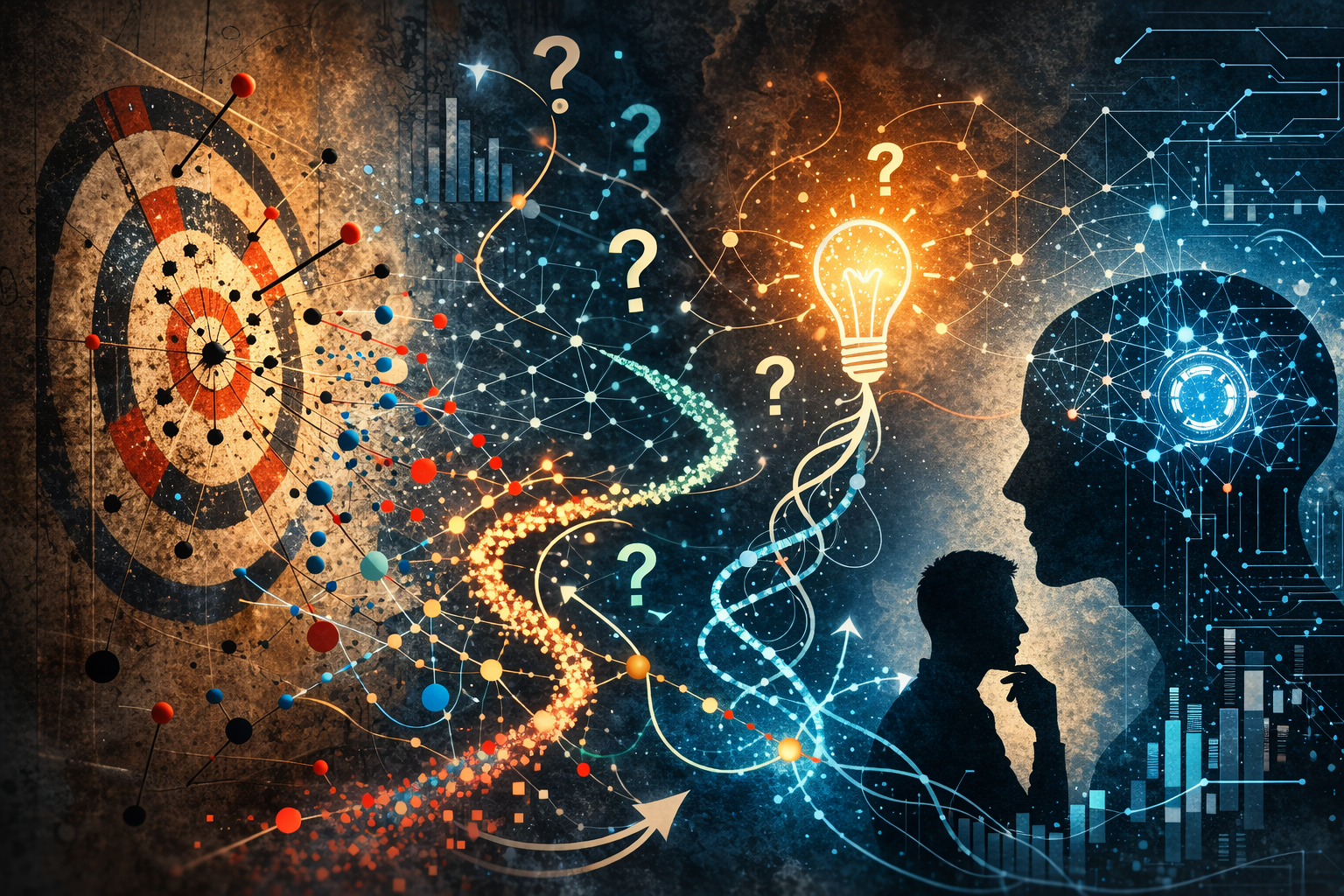
In confirmatory science, that really is a problem. It's called Hypothesizing After Results are Known, or HARKing. A helpful analogy is the Texas Sharpshooter: a shooter fires bullets into a barn, then conveniently draws a target around the holes, claiming his brilliance. Post-hoc claims of this kind are much less impressive than genuinely pre-specified predictions (i.e., I'm going to hit the bullseye). They're less impressive because the experiment wasn't designed to test them, inviting false positives and corroding the credibility of the conclusions.
But most omics isn’t confirmatory science. It’s exploration.
Omics experiments generate vast datasets, revealing metabolites, transcripts, proteins and entire pathways that change with an intervention. And we really care about the surprises. The observations that conflict with, or aren’t accounted for by, our best available knowledge—because they expose a gap in our understanding. And the only way to close that gap is to construct a new hypothesis that accounts for what we didn't expect to find.
Without a new explanation, all you can say is that a particular set of molecules went up or down. The interesting question is why—which is exactly where the knowledge deficit lies.
In exploratory science then, HARKing isn't an epistemic sin. It's the mechanism by which surprise is turned into understanding—earned through independent, confirmatory tests. The real sin comes when people present exploratory conjectures as confirmatory claims.
Are we relying too heavily on omics for ideas?
We tend to call omics hypothesis-generating, but that label doesn't quite capture their essence. Problem-generating is closer. These tools don't point us toward an explanation so much as they expand the set of observations that need explaining. And this can be incredibly helpful, because problems are the substrates of hypotheses.
Seen this way, Frezza's concern shifts: the issue isn't over-reliance on omics for hypotheses, but for problems.
A carefully chosen omic assay can reveal puzzles that targeted approaches would miss, precisely because we tend to focus on familiar regions of the molecular landscape.
But outsourcing scientific problems could have unintended consequences. Identifying novel, important research problems requires extensive reading and literature synthesis—both of which entail drudgery. So when pressure for new research questions rises, it becomes tempting to defer to the tools. Just spray-and-pray omics. The result is research geared toward whatever signal happened to emerge, rather than questions born out of deep understanding and an eye toward clinical relevance.
What's at risk then isn't the capacity to hypothesize. Rather, it's the habits that curate problems and make hypotheses worth having: reading widely, making tenuous connections and holding half-baked ideas in tension.
AI won't replace your hypotheses
The last worry is that large language models (LLMs) will render our creativity obsolete. But this concern mischaracterizes what LLMs do.
These models are trained on incredibly large bodies of text and designed to produce coherent, contextually relevant responses—which is why they can generate plausible explanations. But we shouldn't mistake this for understanding. They carry no model of biological reality and no capacity to assess whether an explanation is credible or merely coherent-sounding. More fundamentally, they can't generate ideas that weren't latent in their training data. We can think of them as sophisticated indexes of existing human knowledge—useful for retrieval and recombination, but not for the kind of explanatory leap that constitutes a truly original hypothesis.
This is why Frezza's concern doesn't quite land. Scientific creativity, at its most valuable, involves constructing new explanations for phenomena that current frameworks fail to account for. That capacity isn't something LLMs possess.
That said, the candidate explanations LLMs produce could still be useful in practice. Through recombining ideas across fields, they may spit out hypotheses that you hadn't considered before. Most of the outputs will be wrong or trivial, requiring triage. But expanding the set of potential explanations available, unconstrained by your priors, could serve to enhance the creative process.
The scientist's role in an AI-assisted research environment is therefore not diminished but clarified. It is to identify real-world problems to solve, produce novel hypotheses, and judge which explanations deserve to be tested. That judgment requires exactly what LLMs lack: a genuine understanding of the world. Which means it remains, at least for now, irreducibly ours.